This notebook demonstrates a baseline approach to sentiment analysis using TF-IDF (Term Frequency-Inverse Document Frequency) vectorization and Logistic Regression. While simpler than modern deep learning approaches, this method provides a solid foundation for understanding text classification.
📚 Concepts
TF-IDF Vectorization
TF-IDF is a statistical measure that evaluates how relevant a word is to a document in a collection of documents (corpus). It balances term frequency with word uniqueness, ensuring that frequently occurring but unimportant words do not dominate text representations.
Components of TF-IDF:
Term Frequency (TF): Measures how often a term appears in a document.
Inverse Document Frequency (IDF): Measures how important or unique a term is across all documents.
Source: GeeksforGeeks
Why Use TF-IDF?
Downweights common words (e.g., “the”, “is”) while highlighting informative terms.
Emphasizes distinctive words, making text classification more effective.
Handles varying document lengths by normalizing term frequencies.
Logistic Regression
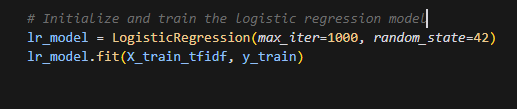
A linear classification model that predicts probabilities using the sigmoid function.
Key Advantages:
Handles high-dimensional, sparse data well (like TF-IDF features).
Interpretable: Provides feature importance via learned weights.
Efficient and scalable, making it a great baseline model.
🎯 Implementation Details
1. Data Preprocessing
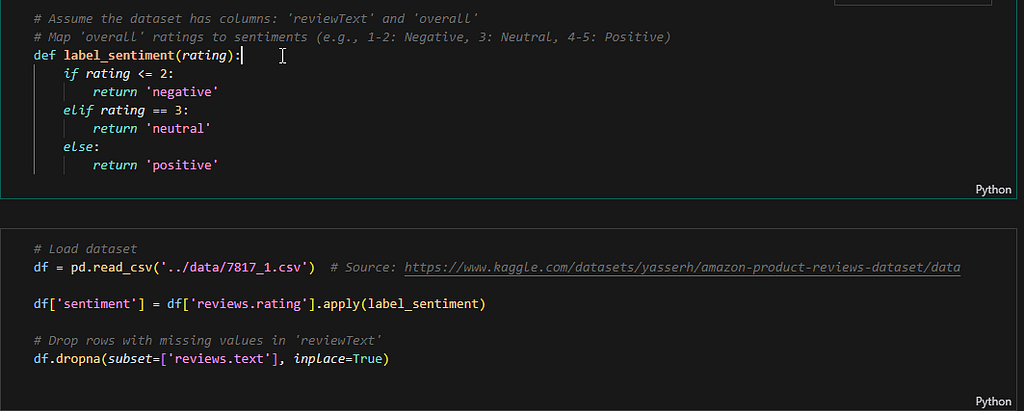
Handling missing values.
Converting ratings to sentiment labels (negative, neutral, positive).
2. Feature Engineering
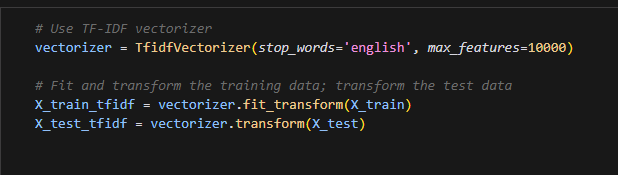
TF-IDF vectorization to convert text into numerical features.
Stop word removal to eliminate common words that add little value.
Feature limitation: Restricting to the top 10,000 most frequent terms to reduce sparsity.
3. Model Training
Train-test split with stratification to maintain class distribution.
1. Bag-of-Words Limitations
Loses word order information (e.g., “not happy” and “happy” are treated similarly).
Cannot capture context beyond individual words.
Struggles with negations (e.g., “not good” vs. “good”).
2. Vocabulary Issues
Out-of-vocabulary (OOV) words in test data may not be well represented.
Sparse feature matrix leads to memory inefficiency.
Fixed vocabulary: Adding new words requires retraining.
3. Class Imbalance
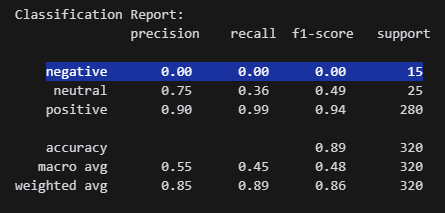
Biased predictions toward the majority class.
Need for proper evaluation metrics beyond accuracy.
Importance of stratified sampling to maintain label proportions.
🚀 Potential Improvements
1. Text Preprocessing
More sophisticated text cleaning (handling contractions, special characters, etc.).
Lemmatization instead of stemming for better root-word representation.
Explicit negation handling (e.g., replacing “not happy” with “not_happy”).
Emoji and emoticon processing for sentiment-rich symbols.
2. Feature Engineering
N-gram features (bigrams, trigrams) to capture phrase-level information.
Custom stop words tailored to the domain.
Part-of-Speech (POS) tagging to identify important words.
Named Entity Recognition (NER) for identifying entities.
3. Model Enhancements
Ensemble methods (e.g., Random Forest, XGBoost) for better performance.
Feature selection to remove noisy terms.
Hyperparameter tuning using GridSearchCV.
More sophisticated cross-validation strategies (e.g., stratified k-fold).
4. Advanced Techniques
Word embeddings (Word2Vec, GloVe) for dense representations.
Deep learning models (BERT, RoBERTa) for context-aware sentiment analysis.
Transfer learning to leverage pre-trained language models.
📊 Evaluation Metrics
Key Metrics:
Accuracy: Overall correctness of the model.
F1-score: Balances precision and recall, especially for imbalanced datasets.
Precision & Recall: Measures of positive prediction quality and coverage.
Confusion Matrix: Provides insights into misclassification.